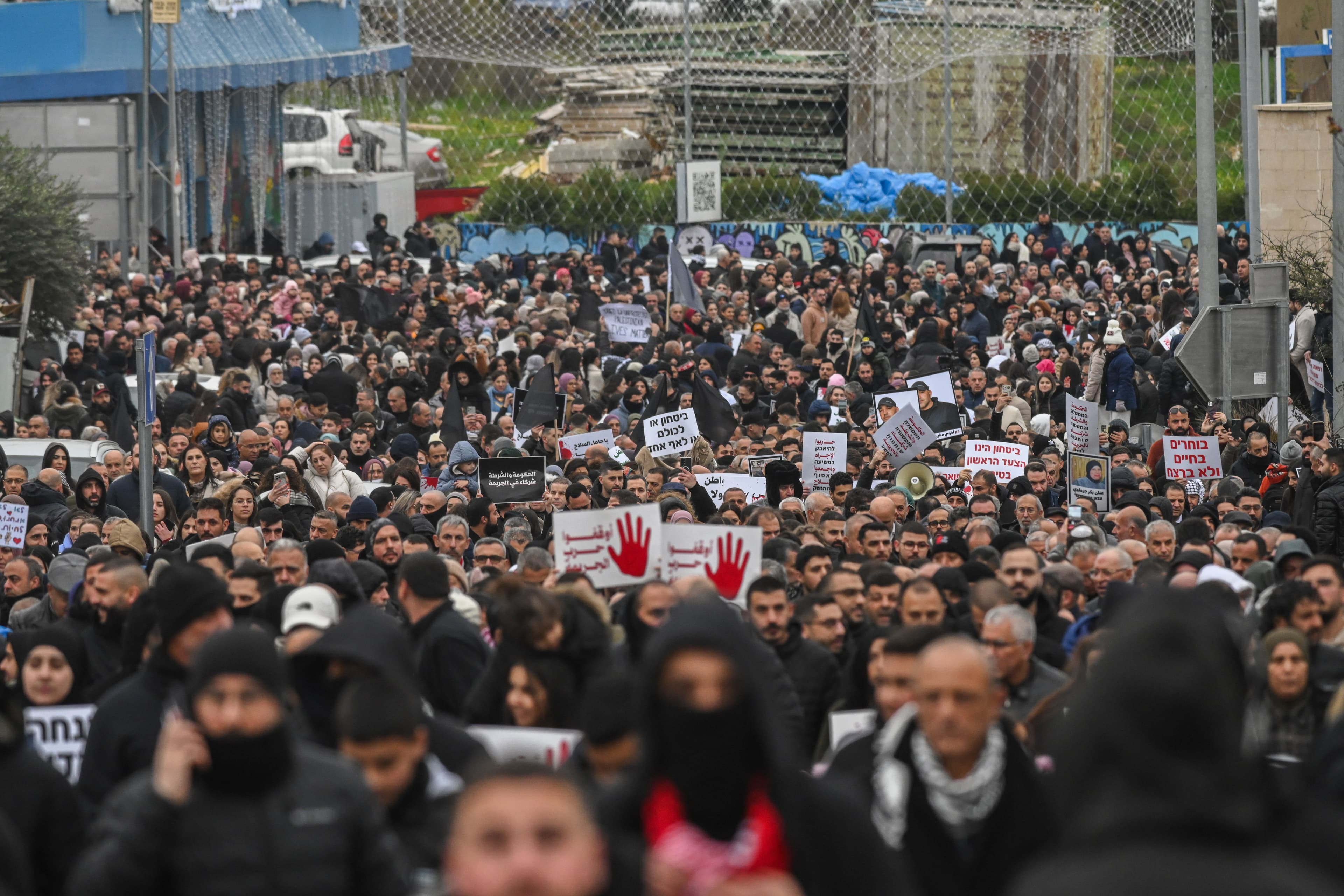
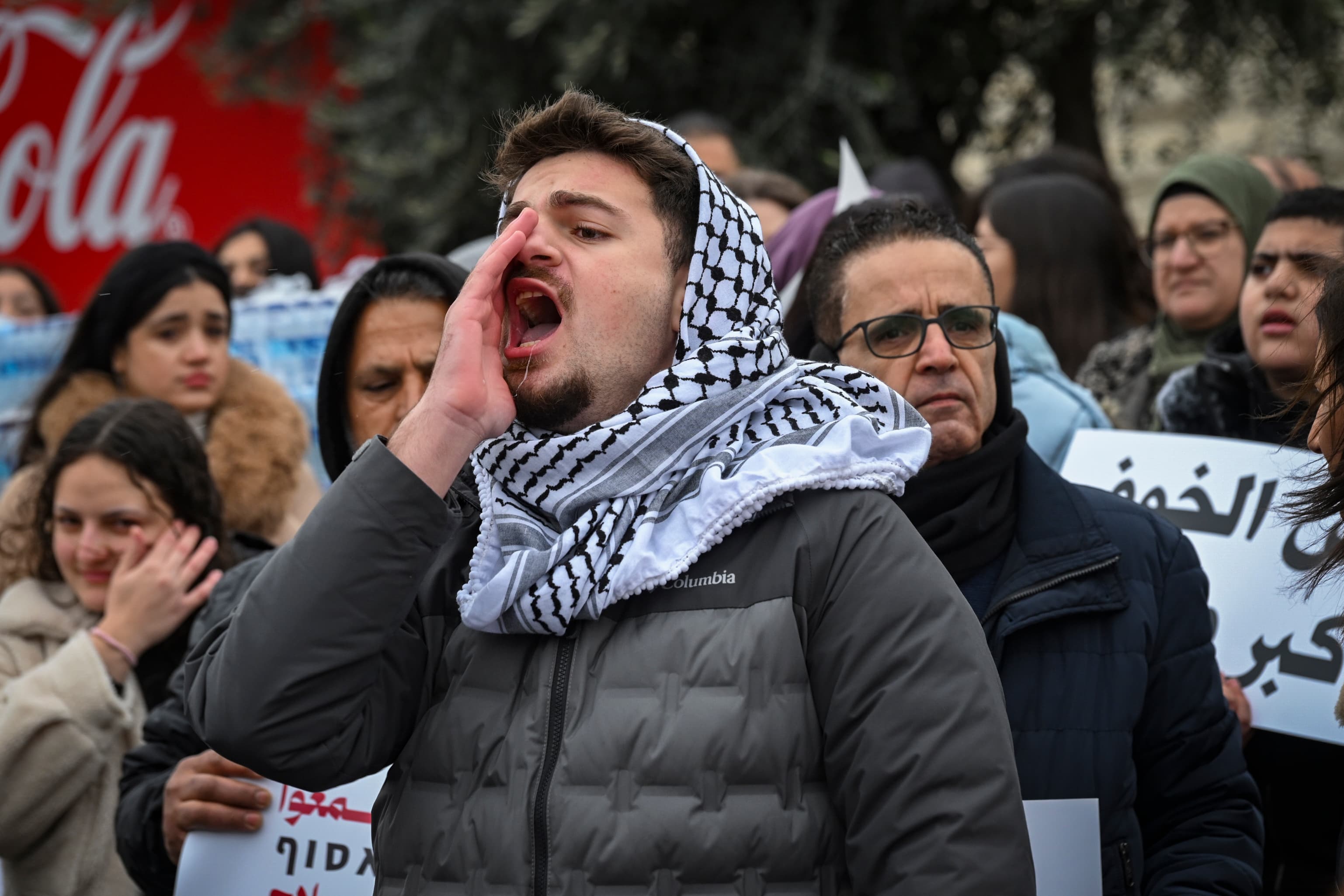
Members of the Arab community in Israel protest against the violence in their community, in Sakhnin, northern Israel, January 22, 2026. Photo by Michael Giladi/Flash90
Refusing to Bleed Quietly
Palestinian Communities in Israel Rise Against Organized Crime
The first time City of God was screened, its depiction of drug gangs ruling Rio’s favelas felt like a distant nightmare: a world where bullets fly with impunity and the state is conspicuously absent. This nightmare no longer feels distant. In Palestinian towns inside Israel, gunfire now punctuates the night, cars are torched in the streets, and organized crime has woven itself into daily life. Fear is no longer episodic; it is permanent.
Funerals have become routine, each one a gathering of mothers, fathers, and young people mourning lives lost to violence and organized crime. Grief quickly turns to anger, not only at the gunmen, but at the Israeli state apparatus that watches, knows, and allows this reality to persist.
The question is no longer how our towns became unsafe, but why this violence has been permitted to proliferate. Though often framed as a problem of criminality, this reality is political in nature and was long in the making. It reflects a deliberate political structure under which Palestinian communities, living inside Israel, are left exposed to internal destruction while their political space remains tightly controlled. Understanding this phenomenon reality therefore requires tracing the conditions that allowed it to emerge.
A Crime Wave Met by Negligence and Complicity
For years, the rise of organized crime in Palestinian communities inside Israel was treated as background noise: murders became routine headlines, extortion an open secret, and fear a structuring condition of everyday life. What has unfolded in recent years, however, is not continuity but escalation. Palestinian communities inside Israel are now experiencing an unprecedented surge in lethal violence. According to a Taub Center study drawing on 2019 OECD data, the murder rate among Palestinian citizens of Israel ranks among the highest in the OECD, third after Mexico and Colombia. Since then, the situation has deteriorated dramatically. Killings more than doubled from 109 in 2022 to 233 in 2023, and reached 252 in 2025, the deadliest year ever recorded. Although Palestinian citizens constitute roughly 20 percent of the population in Israel, they now account for more than 80% of all murder victims in the state. Israeli officials continue to offer rhetorical concern, but policy tells a different story. In 2023, the ultranationalist police minister Itamar Ben Gvir froze the government’s central anti-crime program and slashed budgets to Arab municipalities. At the same time, he made political capital out of arming Jewish settlers and militias, boasting of 100,000 new gun licenses issued to Jewish citizens since October 7, 2023. Palestinian towns, by contrast, remain flooded with unlicensed weapons. approximately 70 percent of illegal firearms in Arab communities originate from Israeli military stockpiles, stolen or smuggled from Israeli Army bases. This is not a failure of intelligence: the security services know exactly how these weapons circulate. The difference is not knowledge, but political will. Criminal Organization’s Impunity is not incidental to this reality; it is a designed policy. Case after case goes unsolved, investigations “drag on,” and known killers walk free. Some hitmen are widely known to have carried out a dozen or more murders without consequence. Gang leaders operate with such confidence that they publicly circulate kill lists and record threats and attacks in broad daylight. The message is unmistakable: there is little to fear from law enforcement. Abraham Initiatives data shows that nearly 90% of murders in Palestinian communities in Israel remain unsolved. This is not a failure of capacity, but a statistical signature of state abandonment.
“Mr. Minister, there is nothing to be done. They kill each other. That’s their nature. That is the mentality of Arabs,” Israel’s police commissioner told Ben Gvir during a discussion on the soaring murder rate.
This pattern of impunity has been acknowledged openly. In 2021, Channel 12 News aired a report quoting a senior police official who admitted that many of the figures leading serious organized crime in Palestinian communities were collaborators with the Shin Bet (Israel Security Agency). ,”our hands are tied” the official said, “ We cannot touch those collaborators, who enjoy immunity.” . This admission suggests a “legal black hole” where the most violent actors are granted a green light to operate in exchange for intelligence. The statement, broadcast on prime-time television and never formally denied, confirmed what Palestinian communities had long understood: organized crime is not merely tolerated, but structurally entangled with the security regime governing Palestinian life. The ideological underpinning of this policy surfaced plainly in April 2023, when a leaked recording captured Israel’s police commissioner, Kobi Shabtai, dismissing the violence as an internal Arab problem. “Mr. Minister, there is nothing to be done. They kill each other. That’s their nature. That is the mentality of Arabs,” Shabtai told Ben Gvir during a discussion on the soaring murder rate. This was not a private prejudice; it was a governing assumption. When the state’s top law-enforcement official frames Palestinian death as cultural inevitability, impunity becomes policy. It is difficult to imagine a clearer case not of state negligence, but of state-enabled lawlessness. This framing, that internal violence is a cultural pathology rather than a policy outcome, mirrors the “Third Force” tactics utilized by the South African apartheid state in the late 1980s. In that context, the security apparatus fueled internal township violence, arming and protecting rival factions to trigger what was then dismissed as “Black-on-Black” crime. The goal was to exhaust the community’s capacity for collective resistance and to delegitimize the liberation struggle by framing it as a symptom of inherent ethnic dysfunction rather than a product of state engineering
Cracking Down on Dissent, Not on Crime
The pattern is unmistakable. When Palestinians mobilize politically, to defend their homes, their rights, and their existence, the state responds with raids, beatings, mass arrests, and long prison terms. When organized criminal organizations terrorize Palestinian communities from within, the response ranges from indifference to enabling.
While gangs wage turf wars openly, another reality looms: when Palestinians mobilize politically, the Israeli state demonstrates that it is anything but absent and responds with overwhelming force. This became unmistakable after the May 2021 “Dignity Uprising” when Palestinian citizens of Israel mobilized against Israeli assaults in Jerusalem and Gaza. In response, Israeli police and security agencies launched a sweeping crackdown. More than 2,000 Palestinian citizens were arrested in those weeks, hundreds of young protesters were indicted, often under “security” or “nationalistic motive” charges, and many received draconian prison sentences. This policy has only intensified. After October 7, repression escalated further. According to Adalah – The Legal Center for Arab Minority Rights in Israel , more than 250 Palestinian citizens were arrested or interrogated in the first month alone for social media posts or protests deemed “incitement” Israeli police launched an intensified crackdown in Palestinian Towns, arresting and interrogating Palestinian citizens for protests and online expression, effectively recasting political dissent as a national security issue.
The pattern is unmistakable. When Palestinians mobilize politically, to defend their homes, their rights, and their existence, the state responds with raids, beatings, mass arrests, and long prison terms. When organized criminal organizations terrorize Palestinian communities from within, the response ranges from indifference to enabling. Youth who wave Palestinian flags or criticize Israeli policy online are labeled “terrorists” and prosecuted under anti-terror laws, while crime bosses livestream gunfire in Palestinian villages without consequence. This is not contradiction but design: political life is criminalized, while internal violence is tolerated, if not encouraged. The state has chosen its enemy, and it is not the mobsters. This repression does not end at the level of policing. Its consequences extend beyond arrests and surveillance, shaping and narrowing the political, social and economic conditions under which Palestinian communities are forced to live. It is within this political and economic suffocation that organized crime finds fertile ground, and their lure may start to make twisted sense. By 2024, 38.4% of Palestinian citizens were living below the poverty line, nearly double the national average, and fully half of Palestinian children were in poverty. When access to meaningful work, affordable housing, and collective political agency is deliberately narrowed, criminal networks present themselves as a route to income, protection, or status. Sometimes through coercion, sometimes through promise. The state then points to the resulting violence as proof of Palestinian “lawlessness” obscuring its own role in producing the conditions that allow such violence to flourish. In response to the crisis, some Israeli officials have proposed a “security-first” solution: reclassifying criminal organizations as terrorist entities and authorizing administrative detention, arrest without charge or trial based on secret evidence. This plan aims to extend draconian powers traditionally reserved for 'national security' into the heart of civilian life in Palestinian towns.
However, this proposal has met fierce resistance from Palestinian civil society and human rights organizations. The fear is not simply that it will fail to stop crime, but that it will succeed in further eroding the civil rights of all Palestinian citizens. By blurring the lines between criminality and political dissent, such laws provide the state with a “gray zone” to bypass courts and suppress Palestinian mobilization under the guise of public safety. For a community already targeted by political policing, the answer is not more state-led repression, but state-led accountability.
A haunting precedent for this “security-first” trap can be found in the 2007 Intervention in Indigenous Australian communities. Under the excuse of an emergency response to internal violence and social dysfunction, the state suspended the Racial Discrimination Act to impose military-style policing and welfare controls. While the state claimed it was “protecting” the vulnerable, it instead created a permanent state of exception that stripped away communal autonomy while failing to reduce actual crime.
For Palestinian towns, the proposal to reclassify gangs as “terrorist entities” threatens a similar outcome: the normalization of a police state that manages the population through surveillance rather than providing the security it grants its Jewish citizens
Organized Crime as a Mechanism of Apartheid Rule
The escalation of organized crime alongside intensifying legal discrimination is not coincidental; the two processes reinforce one another within a single system of multi-layered domination. International human rights organizations, including Amnesty International, have therefore in recent years concluded that Israeli laws, policies, and institutional practices toward Palestinians constitute a system of apartheid, a structured regime of discrimination and domination rather than isolated violations of rights.
Israel is not a democracy grappling with an unfortunate crime problem. What has unfolded is not an aberration within an otherwise functional democracy. It is the outcome of an apartheid regime that governs Palestinian citizens of Israel as a population to be managed, fragmented, and kept subordinate. While this system of domination operates through different mechanisms across geographic and legal contexts, governing Palestinian citizens of Israel through civilian rule and structural control, enforcing military occupation in the West Bank, and maintaining military blockade and siege in Gaza, it forms part of a single overarching structure that functions in differentiated but interconnected ways. Within such a system, organized crime does not represent a failure of governance; it functions as a mechanism of control.
This dynamic is not new. As early as 2003, the Or Commission stated that Israeli police view Palestinian citizens as enemies. Over time, this approach hardened into the present reality: criminal networks operating with near-total impunity, producing fear and fragmentation that serve clear political ends. Under an apartheid regime, such fragmentation is not a side effect but an asset, a society consumed by funerals, extortion, and mistrust is less capable of organizing against structural discrimination, asserting collective rights, or mobilizing in solidarity with Palestinians in the West Bank and the Gaza-Strip.
Grassroots Resistance: From Civil Mobilization to Political Struggle
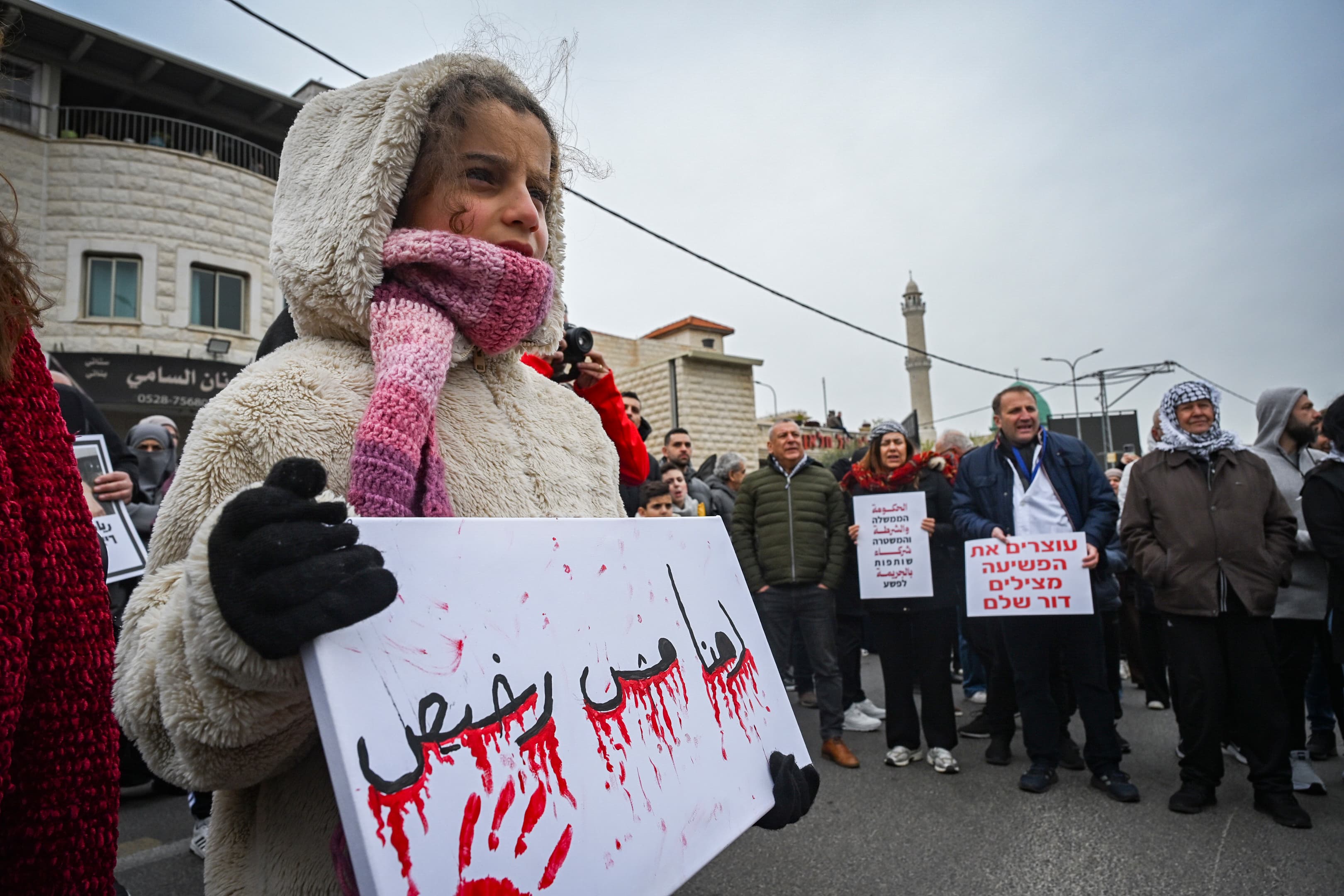
Since the beginning of 2026, up to 24 March, 58 Palestinian citizens have been killed. This figure does not include the injured. It is against this backdrop of abandonment and repression that Palestinian communities have begun to refuse the role assigned to them. In the face of organized crime on one side and state repression on the other, a grassroots movement has emerged that transforms what is often dismissed as “civil protest” into political resistance from below. One early and emblematic example emerged in Tamra in early 2025. After a 17 year old student, Jawad Yassin, was killed by gang crossfire, the town responded with a general strike that shut down schools, shops, and public services. The initiative did not come from political parties but from a broad coalition of local actors: the municipality, popular committees, mosque imams, parents’ groups, youth representatives, and even the high school student council. Their joint statement was unambiguous: society would no longer stand idly by in the face of organized crime. Thousands marched from the town center to the police station, openly accusing the state of negligence and complicity. Similar mobilizations soon unfolded across the Galilee and the Naqab, organized by ad-hoc coalitions of merchants, families of victims, youth activists, religious leaders, and neighborhood committees rather than traditional political elites.
By late 2025 and into early 2026, these localized actions converged into an unprecedented collective uprising against organized crime. In January 2026, a chain of grassroots action in Sakhnin ignited one of the largest mass mobilizations in the history of Palestinian society inside Israel. What began with a single business owner, threatened by a criminal organization, declaring an individual strike, escalated into a citywide shutdown when other shop owners quickly followed, pushing the issue into the public sphere. As Sakhnin moved, other towns followed. Popular Committees declared strikes, and the High Follow-Up Committee called for a general strike across Palestinian communities and a mass demonstration. Its estimated that 100,000 Palestinian citizens ultimately participated, marking a clear escalation from local defiance to collective national action.
What distinguishes this wave is its bottom-up character. In several towns, grassroots safety patrols and reconciliation committees have reemerged, with residents mediating disputes before they escalate or physically preventing gang incursions when police fail to intervene. Coordination did not flow through party headquarters or parliamentary offices, but through informal networks built over years of social struggle: business owners, parents’ committees, youth groups, and local popular committees. Strikes were often initiated through direct conversations within the community, spread via WhatsApp groups and personal networks, and then formalized by municipalities. Families of victims played a central role, transforming private mourning into public mobilization and insisting that grief itself become a political force. In this way, leadership emerged horizontally, rooted in lived vulnerability and collective responsibility rather than institutional leadership. This is not vigilantism but a form of collective self-defense rooted in social solidarity. What is now emerging raises questions that extend beyond mobilization itself. Protest alone, no matter how massive, cannot sustain itself indefinitely without consolidating into durable political and organizational structures capable of shaping collective life. What makes the current moment distinct is that it has begun to move beyond protest as an event and toward organization as a process. Popular Committees, municipal coordination, and grassroots protection initiatives are not only resisting violence, but also rebuilding political infrastructure from below.
For example, the Sakhnin mobilization demonstrated that this shift carries immediate political consequences. What began as a grassroots act of refusal quickly generated pressure on formal political leadership, culminating in a public declaration by the heads of Israel’s four Arab-majority parties expressing their intention to restore the Joint List
This was not merely symbolic, but evidence that bottom-up mobilization can compel leadership to respond to the collective will emerging from the street. At the same time, it underscored the indispensable role of political parties in transforming dispersed acts of resistance into sustained collective power. Unlike localized initiatives, parties possess the organizational continuity, national coordination, and institutional capacity necessary to unify fragmented struggles, articulate shared political demands, and confront state structures at scale. Grassroots mobilization can ignite political rupture, but without organized political parties capable of consolidating and directing it, such moments risk remaining reactive and vulnerable to exhaustion. The relationship is therefore not one of substitution, but of political necessity: grassroots organizing generates the force of collective action, while political parties and political leadership provides the structure through which that force can endure, expand, and reshape the conditions under which Palestinian communal life is governed.
This mobilization is political in the fullest sense. A population rising collectively to demand security and dignity in defiance of both criminal networks and a hostile state is engaging in political struggle.
This awareness has reshaped the protests themselves. Anti-crime demonstrations increasingly include chants against occupation and racism, linking the violence inside Palestinian towns to the broader condition of Palestinians under Israeli rule, from Gaza to the West Bank. The slogan “One people, one destiny, one future,” heard at mass rallies in Rahat, captures the political horizon that animates this movement: the refusal to treat Palestinian citizens inside Israel as an isolated case, separate from the fate of the Palestinian people as a whole.
Refusing to bleed quietly
The uprising against organized crime in Palestinian communities in Israel marks a decisive rupture with the logic of abandonment imposed by the Israeli state. It exposes violence not as a social pathology but as a political condition produced and managed through a governance structured by apartheid. By organizing from below—through strikes, popular committees, and collective refusal—Palestinian communities are reclaiming agency in a landscape designed to strip it away. This struggle is not only about safety in the streets; it is about rejecting a regime that criminalizes Palestinian political life while tolerating internal destruction. In insisting that life, dignity, and security are collective rights rather than privileges, Palestinian society in Israel is asserting a simple but radical truth: there can be no justice without dismantling the structures that render Palestinian suffering acceptable. Refusing to bleed quietly is, ultimately, a refusal to be governed through fear, and a declaration that life, dignity, and collective safety are not privileges to be granted, but rights to be claimed. Declaration that survival itself is a form of political act.
Author
Donia Abbas is a project manager at the Rosa Luxemburg Foundation’s Israel office in Tel Aviv.
