
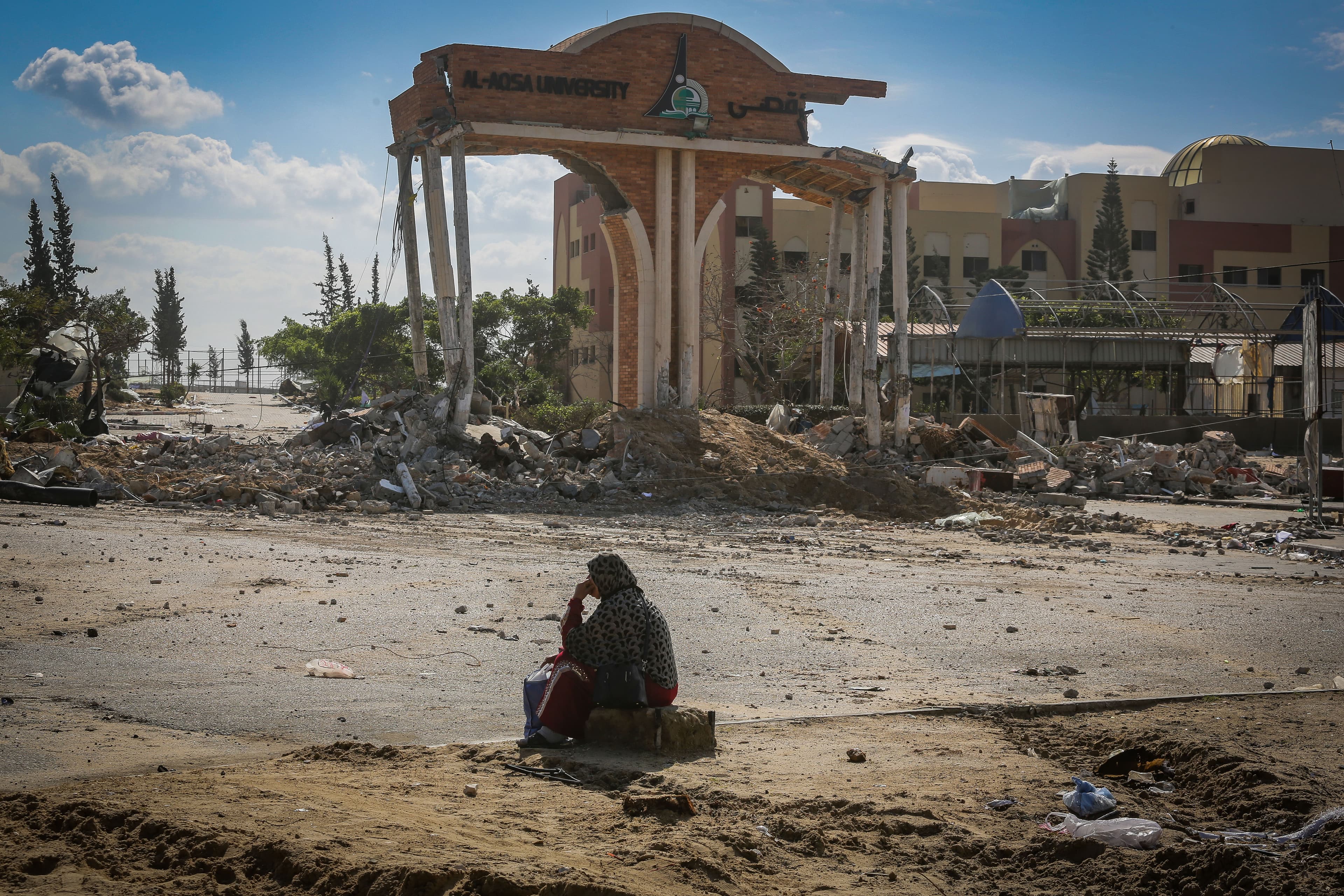
The ruins of the destroyed Al-Aqsa University in Gaza, January 2024. Foto: Flash90
Militarism in the Israeli Academia
Israeli universities as part of the machinery of institutionalized violence
The Rifle in the Classroom: On the Genealogy of a Mobilized Academia
“The connection between academia and the training of the future generation of ground-forces commanders produces a seed that we are planting today and we will reap its fruits in the future.”
Senior official at the Israeli Ministry of Defense, quoted in an article on the military-academic Erez programme of the Ministry in co-operation with Tel Aviv University, TheMarker 2023.
“The new students will be integrated into a variety of fields in dual-major tracks in social studies, management, sciences, and high-tech, and we see this as another expression of the university’s contribution to the resilience and development of society and the state.”
Prof. Eyal Zisser, Vice-Rector of Tel Aviv University, ibid.
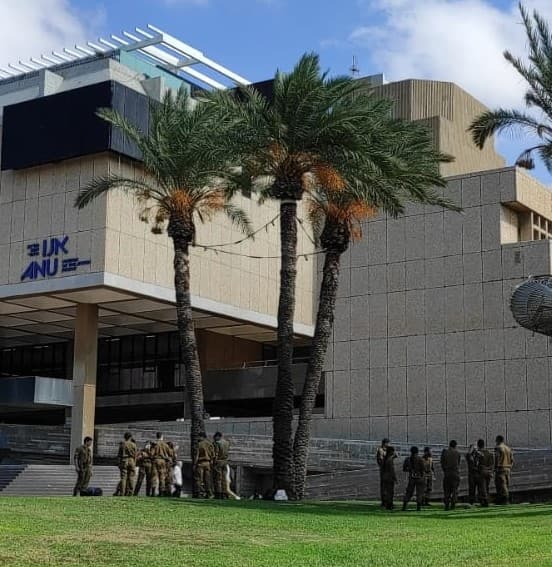
A group of soldiers in military uniforms sits on the lawn outside the Faculty of Humanities at Tel Aviv University. Another cluster of armed, uniformed soldiers gathers at the entrance to the Faculty of Mathematics at the Hebrew University in Jerusalem. In a large hall at the University of Haifa, hundreds of teenagers sit listening to a lecture by Major General G., a senior military officer, about the various military-academic tracks to which they can apply. Programs which several university representatives - professors, administrators, and the like - also take the stage to praise. Two students sit in a class in The Technion Faculty of Aerospace Engineering. Later that day, they speak with recruitment representatives in a booth the arms company Elbit Systems has set up as part of a campus career fair. At Ben-Gurion University, several students talk with recruitment representatives from the Mossad (state security). A few steps away, another group chats with Shin Bet (intelligence agencies) recruitment agents. The students fill their pockets with chocolates from a transparent plastic bowl at the booth. At the laboratories of the Hebrew University of Jerusalem, chemists bend over an electron microscope and examine the structure and thickness of a layer revealed through the lens as part of an experiment with Rafael Advanced Defense Systems Ltd.
All these fragments emerge from a larger picture revealed by turning one’s gaze at academia in Israel: an institution that, from teaching to research, from discourse to thought, is mobilized towards Israeli militarism.
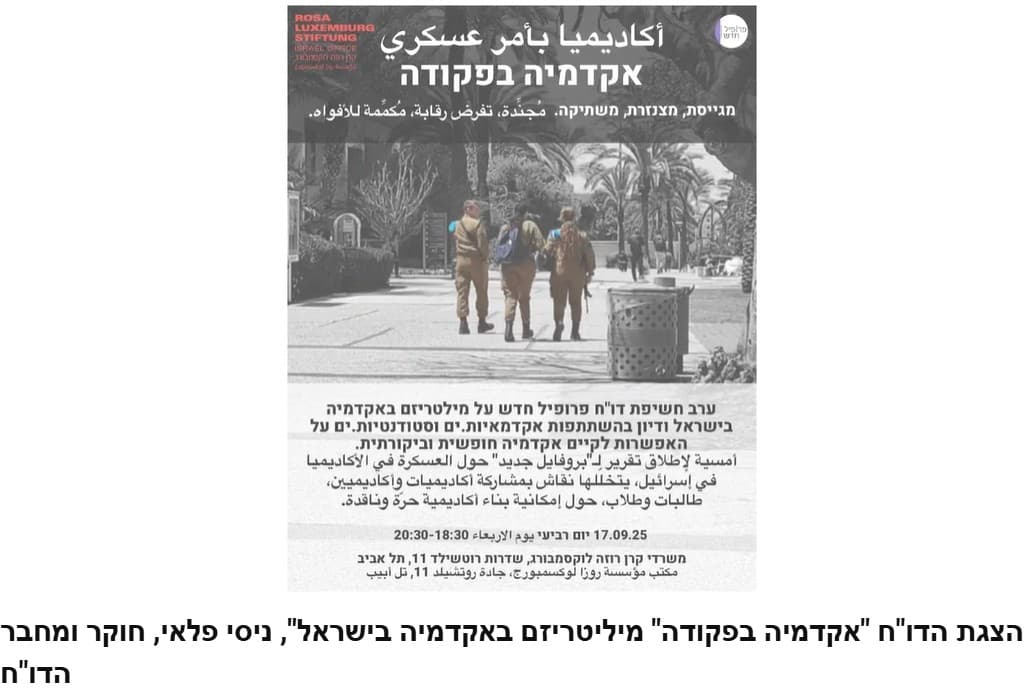
In this essay, I present key findings from an activist research report we published in New Profile — The Movement to Demilitarize Israeli Society this year, “Academia under Command: Militarism in Israeli Academia”.
The original report maps and analyzes the extensive and ongoing cooperation between institutions of higher education in Israel and the defence establishment and arms industry, showing how this cooperation shapes academic institutions and academic life. The present essay outlines how this cooperation turns academia into part of the machinery of institutionalized violence, and presents several findings not included in the original document, concerning manifestations of academic militarism over the past two years. Toward the end of the essay, I place Israeli academia before its mirror image — Palestinian academia, and propose several directions for action and thought: ways of objecting to these processes, from both within and outside academia, and from both within and outside Israel/Palestine.
In Israel, the broad term “defence establishment” commonly refers to a range of different bodies. They are interwoven and rely on one another, feeding each other with knowledge, resources, and people. Officially, these include the military, police, and state security and intelligence agencies (the Mossad and Shin Bet). More broadly, they also include the Ministry of Defence and the arms industry (both public and private). Israeli academia has substantial and deep ties with many of these organizations.
Generally, academic work can be divided into two main facets: teaching and research. In two articles published in the 2010s, historian Elad Neemani traces the beginnings of academic militarism in Israel in the field of teaching.
As Neemani explains, in the early days of the Israeli state, the military already saw the civilian education system, from kindergartens to universities, as a strategic sphere for influencing civilians: a sphere whose resources it could use for its material and political needs. Intervention in the educational sphere in general, the military understood, could help justify the high budgets they demanded, and preserve the public legitimacy of compulsory conscription. In the academic context in particular, they believed, there existed an educated, affluent, and powerful stratum whose extensive knowledge could be harnessed.
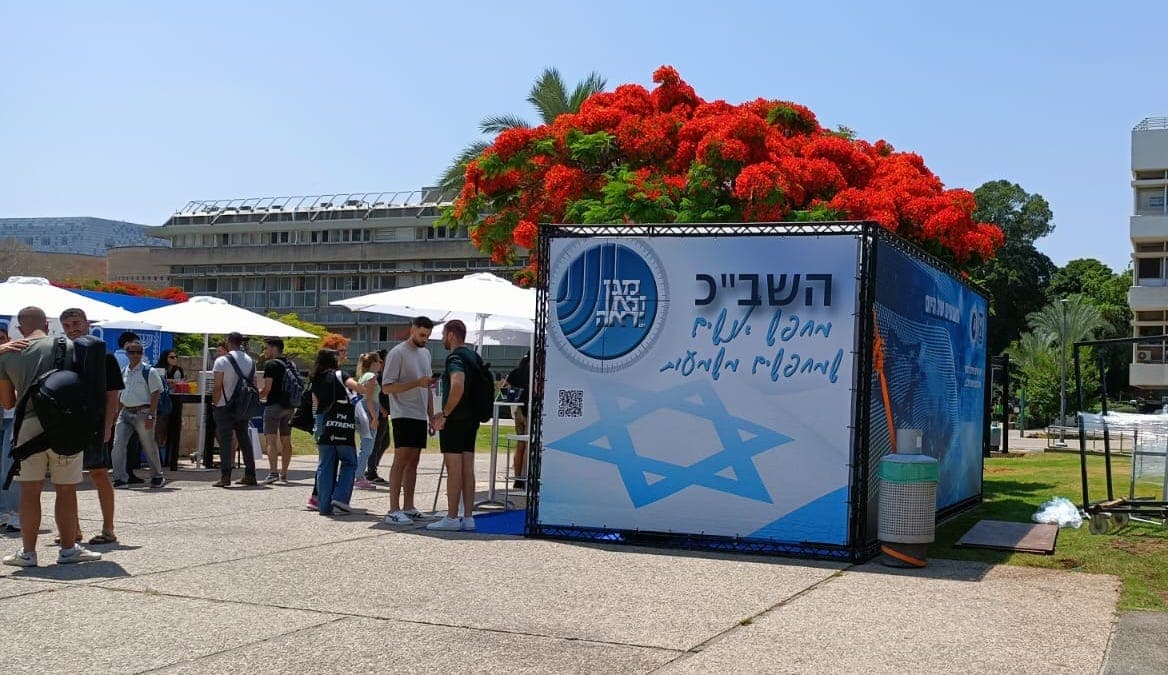
Intervention in academia began in 1951, when David Ben-Gurion, one of the state’s key founders and its first prime minister, ordered the establishment of two military-academic tracks in the Hebrew University and the Technion. The move initially encountered mild resistance from academic institutions, but over the years this resistance completely dissipated: as of 2023, at least 54 military-academic programmes training soldiers for military roles were operating in Israeli academic institutions. According to the Ministry of Defence’s response to a Freedom of Information request, this cooperation generated nearly 270 million Shekels for Israeli academic institutions between 2019 and 2022.
These training programmes are diverse, and are managed and operated by different bodies and military units. At the Hebrew University, for example, the Talpiot programme has been operating since 1979. It is managed by the Israeli Air Force and the Directorate of Defence Research and Development in the Ministry of Defence, with the aim of training R&D officers for the ministry and the Israeli military. The Psagot programme, operating at Tel Aviv University, Ben-Gurion University, and the Technion, is branded by the military as “the excellence programme of the academic reserve” (the military uses similar superlatives to describe many military-academic programmes) and also trains weapons developers for the defence establishment.
The Odem programme, launched about three years ago, recruits teenagers - some as young as 14 - into a twelve-year track with the same goal. It is managed in cooperation with the Technion, the Ministry of Defence, the Mossad, Shin Bet, Rafael, and other companies in the military industry.
Similar to screening and recruitment processes for other military roles in Israel, these programmes select teenagers, usually around the age of 16. Following acceptance, they sign a draconian contract that binds them to the military system at least until their mid-twenties, with almost no possibility of withdrawal. High schools and academic institutions themselves participate in marketing and encouraging youth recruitment to these programmes.
They do so, for instance, by hosting expositions and special events in cooperation with the military, and by advertising them on official university websites and social media. In many cases, the Council for Higher Education in Israel and the academic institutions adapt and tailor curricula and eligibility conditions to the military’s needs. In the tender for the Erez programme, for example, aimed at training combat commanders and launched at Tel Aviv University in 2024, the Ministry of Defence required that one-fifth of the academic degree credits be granted in exchange for military training, completed before the soldiers even set foot on campus.
Sometimes, the military’s demands of its academic partners reach the level of comic absurdity: in the same tender, the military required that soldiers “be given priority in borrowing books, as well as the ability to borrow additional books in accordance with institutional guidelines”, that lecturers teach on military bases according to military needs, and that professors refrain in their classes from the use of “offensive statements” toward soldiers, their uniform, and their military service.
Collaborations also pervade research. Many academic institutions conduct joint or commissioned research for the Ministry of Defence and the military industry. In recent years, several weapons companies have established R&D centers near academic institutions to tighten the military-industrial-academic nexus. In a news item published on Ben-Gurion University’s website in 2019 concerning a new research cooperation agreement with Rafael, a university representative stated that they “expect a close cooperation with Rafael”, which they described as “a global leader in advanced combat systems.”
The representative added that the company’s R&D branch was established near campus precisely to “benefit from the university’s talent and expertise.” Rafael gave the media a similar explanation when it established such a centre near a Hebrew University campus in 2017. In response to a Freedom of Information request we submitted to the Hebrew University in 2023, the institution provided information about a 3 million Shekels research collaboration with Rafael, and an additional cooperation with the Shin Bet worth 500,000 Shekels. The University itself acknowledged that this was only partial information, whose publication was permitted by the cooperating bodies. To the University’s credit, it at least provided some data: almost all other universities we contacted categorically refused to provide information on their military-related research collaborations, using various pretexts, frequently claiming confidentiality based on “state security” clauses in the FOI law. And yet sometimes even a single quotation contains a larger truth. Here are the words of a senior vice president for R&D at Rafael who also wears the hat of an academic as a lecturer at the Technion from over a decade ago: “There are symbiotic connections between us and the Technion. 70 percent of Rafael’s engineers are Technion graduates. Our relationship with academia is a necessity."
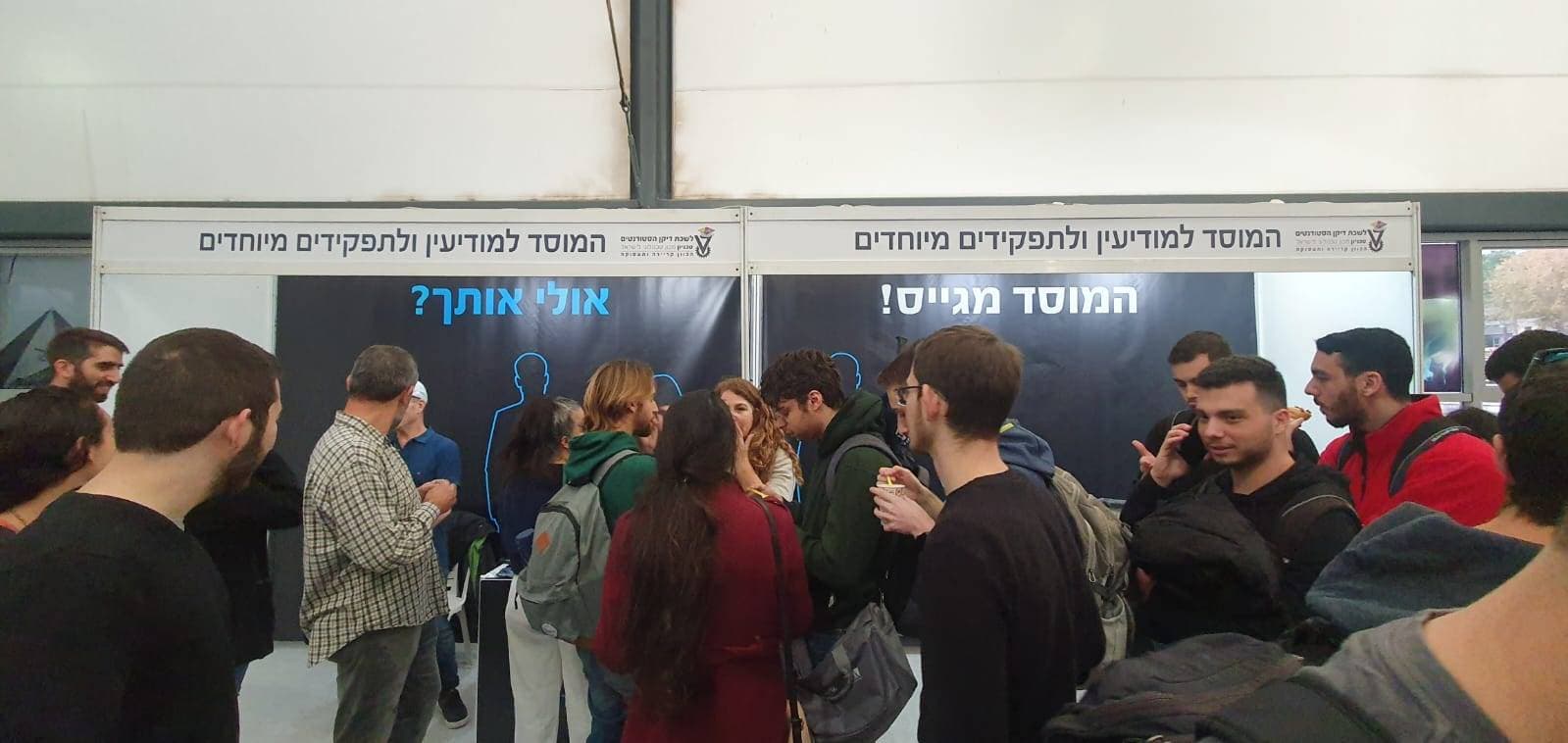
Militarism in Israeli academia is not limited to direct and tangible cooperation with the defence establishment and military industry. It is also expressed in other areas of academic life. In admissions processes at many academic institutions, applicants are required to share information about their military service (or non-service); in admissions to student housing (a scarce and valuable resource in the country’s academic landscape), eligibility points are granted to those who served in active or reserve duty during the course of the academic year of application; all institutions grant academic credits towards degrees for reserve service; and many scholarships, including those awarded by academic institutions themselves, are offered exclusively to military service members, with various academic conditions often tailored to this group, including study accommodations granted to reservists.
In various cases, student housing was converted into full-fledged military bases for soldier-students participating in military-academic programmes.
Academic institutions also cooperate in recruiting students for military-industry companies, the Mossad, and the Shin Bet at campus career events and even in the form of joint courses, such as the Innobit programme managed by Elbit Systems and the Faculty of Engineering at Tel Aviv University. Moreover, academia cooperates with military bodies in organizing and hosting “security” conferences featuring senior military figures.
As a result, the physical academic space itself is flooded with armed and uniformed soldiers and students carrying guns.
All these components directly affect academic structures and the academic habitus. Academic militarism sometimes leads to militaristic discourse by lecturers, and to changes in the nature of courses and even entire academic departments. There is a conspicuous paucity of research and critical discourse on government policies and military actions and the negative impacts of militarism on civil society. This results in the systematic exclusion of students and academics - primarily, but not only, Palestinians - from Israeli academia. This is attested to by the words of three of the students we interviewed for this report. According to one, there are nearly no Palestinian students in the Technion Faculty of Aerospace Engineering, due to its pervasive cooperation with military-industry companies Rafael and Israel Aerospace Industries.
The other said she left the Hebrew University's Middle East and Islam department because of the “security-centred discourse.”
A young Palestinian student spoke of the dilemma she faces: if she continues an academic career at an Israeli university, she will be forced to give up her political activism. But most importantly, the close relationship between militarism and academia turns the latter into an institution that plays a substantial role in maintaining and refining Israel’s apparatus of institutionalized violence.
Israeli academia’s decision to co-operate with military mechanisms and the military industry can be explained in several ways. The first (and probably most central) is a conscious ideological-political choice: many heads of academic institutions and members of the academic community simply identify with Israel’s militarist-Zionist values. Another is economic and neo-liberal in nature: the direct income that military-academic co-operation generates for institutions, alongside the symbolic capital they gain from this association, in the form of prestige and status accorded to military bodies and companies in Israel’s militaristic social consciousness. This combination of the ideological and the economic makes academic institutions with substantial ties to the defence establishment seem more attractive to potential students and faculty. Simultaneously, in a feedback loop, it makes them more desirable to military bodies and weapon companies themselves.
Militarism, of course, does not skip past the students themselves.
Historically, student movements around the world have played a central role in political struggles against national-militaristic consensus. Yet this phenomenon is nearly non-existent in Israel. Quite the opposite, in fact.
The National Student Union has repeatedly expressed support for Israel’s genocide, which it terms a “war”, since October 2023.
Recently, it even called for students to go on strike to demand the drafting of ultra-Orthodox Jews (who are historically de facto exempt from military service in Israel). This is not surprising: nearly 30% of students in Israel are registered as reservists. Added to that is another closely related cause for student militarism: most students arrive at academia after years of indoctrination in the pre-academic education system, often shortly after completing their compulsory military service in the formative years of young adulthood. As shown in our report, academia does not invest much effort in challenging students’ political perceptions, because it itself constitutes an integral component of Israel’s militaristic order.
ⅠⅠ. The Sewing Machine and the Machine Gun
Several anecdotes from the past two years vividly illustrate this essay’s (and the report’s) claims:
In the weeks following the 7 October 2023 attack, Israeli media was flooded with articles about the mobilization of Israeli society for the war effort and the strengthening of civilian “national resilience” on the “home front.” Alongside reports of Israelis volunteering to help farmers in the Gaza envelope pick tomatoes or assist in the unloading of military equipment from American cargo planes, several articles and reports highlighted the involvement of academic institutions and academics in the immediate national-war efforts.
These reports noted that Israel’s three major art schools - Bezalel, Shenkar, and WIZO - joined the production effort of military equipment to support Israel’s ground offensive in Gaza that began on 27 October 2023.
The Israeli magazine AT published an article describing how, following a request from the Ministry of Defence, Shenkar’s fashion department opened an “emergency sewing workshop” to sew military equipment “for the benefit of battalions and companies operating in the battlefield”. According to the piece, “dozens of lecturers and students enlisted”, intensively sewing “specific accessories tailored to the vests of combat soldiers”.
Maya Arazi, a lecturer at the department, told AT that they worked “with the IDF and according to its demands”.
An article from ynet described how the art students “sewed pouches for magazines and medical equipment, and rear pouches” for the Israeli “elite” combat units 669, Maglan, and Egoz. A senior lecturer at Shenkar clarified that the Ministry of Defence requested assistance in preparing "equipment for units, such as bandoliers (military pouches) and grenade pouches attached to vests”, and that “liaison personnel make the connection between military units and the workshops set up in all the academic schools”.
Similar workshops were also set up in Bezalel and WIZO. The head of Bezalel’s Jewellery and Fashion Department told ynet that the school set up a workshop sewing protective cloaks, grenade pouches, and bandoliers, as well as repairing uniforms and military equipment for soldiers and reservists.
A news item posted on Bezalel’s website, under the title “Emergency Design”, described how the department head and another lecturer “analyzed the needs of fighters from the Givati reconnaissance unit, Yahalom, and Egoz units and began producing products they need in order to fight” .
The phenomenon of guerrilla workshops producing military equipment was not limited to academic art schools. At Ben-Gurion University, students and staff established a workshop for producing and printing military equipment and accessories for soldiers using 3D printers in university laboratories. According to an article in Maariv, the lab, which included over 200 volunteers, both students and engineers, produced over 20,000 units of military equipment, “according to needs that arose in the battlefield”.
The project’s initiator told Maariv that faculty members offered additional laboratories to assist in the printing effort, and that the initiative also received official support and funding from the University and the student association.
Ben-Gurion University, of course, is only one example of a university that mobilized directly and openly for the war effort. In November 2024, Tel Aviv University boasted on its official social media pages that it was operating an “engineering war room” to develop technologies for the military.
Open co-operation between academia, the military, and Israeli militaristic culture over the past two years was not limited to sewing machines and printers. According to an article in Maariv from the end of 2023, the Planning and Budgeting Committee, the Council for Higher Education of Israel, and the National Student Union decided on a student support plan which included awarding 12,000 scholarships to reservists. Many universities announced additional grants of their own, sometimes conditioning the scholarship amount on “contribution to the war or social effort”. Tel Aviv University expressed hope for a significant increase in the grant, “especially for those serving in combat or combat-supporting units”.
Beyond these anecdotes, all signs indicate that academia continued its routine cooperation with militarism in Israel, including training soldiers for military roles, military-academic research, and recruiting youth to the military and students to the defence establishment and military industry.
The general policy of Israeli academic institutions over the past two years was characterized by four main components: alignment with the state and military; avoidance; silencing; and self-victimization. Alignment and avoidance manifested, at best, in the overall silence of heads of academia on the government’s policy and the military’s actions. For almost two years, not a single head of an academic institution in Israel voiced even one mild reservation or critique of the total destruction of Gaza, including the annihilation of the supposedly collegial institutions of Palestinian academia. Finally, in July 2025, the five university presidents of the Hebrew University, Tel Aviv University, the Open University, the Technion, and the Weizmann Institute sent a letter to Prime Minister Benjamin Netanyahu - the presidents of the universities of Ariel, Ben-Gurion, Bar-Ilan, and Haifa refused to sign - in which they called for a solution to the “grave problem of hunger prevailing in Gaza”, and expressed criticism of the government’s policy of deliberate destruction, its genocidal rhetoric, and its then-current plan to create a “humanitarian city”. Even here, they emphasized that “the release of the hostages and the reduction of harm to our soldiers are paramount goals”. More prevalent in Israeli academia was an alignment with government positions, including adopting its genocidal rhetoric: for example, in the “Amalek” speech made by Tel Aviv University’s president in 2023, and in an article justifying Gaza’s destruction, written by Prof. Evyatar Matania the same year. Silencing manifested in hearings, dismissals, and suspensions of students and academics suspected of deviating from the militaristic ethos and Israeli society’s vengeful consensus. In March 2024, Prof. Nadera Shalhoub-Kevorkian was suspended from her post at the Hebrew University after stating in an interview that Israel was committing genocide in Gaza.
In November 2023, the Adalah Center reported receiving over 120 requests for support from Palestinian students, from 36 different academic institutions, against whom disciplinary proceedings had been opened. The fourth component, self-victimization, appeared mainly in response to the expanding academic boycott of Israel: an unwillingness and inability amongst Israeli universities to take responsibility for and acknowledge their role in Israel’s military apparatus, while accusing the movement of “antisemitism.”
ⅠⅠⅠ. A Mirror Image
Until 7 October 2023, 12 academic institutions operated in Gaza.
According to an interim report by the UN Office for the Coordination of Humanitarian Affairs, Israeli military attacks over the past two years spared none of them. The military destroyed nearly 60 academic buildings, thousands of students and academics were killed, and all students and researchers lost access to higher education. On January 17, 2024, it was reported that the last university in Gaza had been destroyed.
The loss of human lives was aggravated by the destruction of valuable, irreplaceable academic material, and robbing thousands of Palestinian students and academics of their future. For many in Gaza, as elsewhere in the world, to enter the gates of a university means to enter the gates of the world. Many people worldwide cling to the academic dream as a bureaucratic and economic anchor for migration, even if temporary.
Israel’s long-standing blockade of Gaza leaves few options for those who can and wish to escape it on their own. Historically, one such path is pursuing studies outside of Gaza. But after the destruction Israel has wrought over the past two years, many have been left without an academic roof, and thus without a possible lifeline from siege, deprivation, and the terror of death.
For years, the Israeli military has used claims that Hamas fighters hide within civilian populations as justification for the high number of civilians killed in its operations. Often, a version of this argument is used by military spokespersons to justify attacks on academic institutions in Gaza, claiming that they are utilized to train fighters for Hamas’s military wings and to develop weapons.
And what would Israeli academic institutions say in their defence of their own entanglement with genocide? Even if the military’s claims about Hamas’s involvement in Palestinian academia were true, they represent a double and distorted morality. Imagine another army using this argument to justify dropping thousands of bombs on the Hebrew University and the Technion because they assist the Israeli military in training soldiers and conducting research. The imagined moral superiority of Israel’s liberal class does not, however, allow it to perceive such an analogy or to internalize its implications.
IV. Towards a Free Academia
The philosophers have only interpreted the world in various ways; the point is to change it. (Karl Marx, Theses on Feuerbach, 1845)
In April 1933, the philosopher Martin Heidegger, who was a member of the Nazi party, was appointed rector of Freiburg University. The day before, Wilhelm von Möllendorff was dismissed from this position for refusing to fire Jewish faculty members, remove “non-Aryan” books from the library, and disseminate antisemitic propaganda throughout the university. Möllendorff’s dismissal and Heidegger's subsequent brief and shameful rectorship were a small expression of a broader policy that shaped German academia during the Nazi regime. Among other measures, universities across the Reich were forbidden to employ Jewish and opposition faculty members, and limits were imposed on the number of Jewish students allowed to enrol, until their enrolment was banned altogether. The collaboration of German academic institutions with the racist and brutal dictates of the Nazi regime helped normalize Nazi fascism and left a dark stain on their legacy.
At least in its modern incarnation, academia has often identified itself as a vital institution in civil society: a space for producing and advancing knowledge, culture, and society as a whole. As such, it is seen as a space that grants those who enter it academic freedom, open and critical discourse, and equal opportunity. At the same time, academia has often contended with the tension between the universal and the particular, or between human and national morality. On the one hand, it is part of an international community of knowledge sharing, joint research, and exchanges of students and academics. On the other hand, each academic institution is rooted in a specific national state and society, composed of their individuals and moral values, and dependent on them for its economic and political existence.
I began collecting findings for New Profile’s report in January 2023.
When I told others about the project, I was often asked whether it was academic research, or if I was writing it as part of a thesis. I replied, with some amusement, that on the contrary, it was anti-academic research. By this I mean, not that it completely rejects academic methodologies or the legitimacy of the academic establishment, but that it points to fundamental flaws in the form of organization and academic being in Israel and elsewhere. As such, my hope is that it offers a different way of looking at its structures and choices, which may lead to introspection, rethinking, and change within academia itself.
The ongoing and deepening militarization of Israeli academia must be understood as one element within the broader process of militarization encompassing Israeli civil society as a whole. This process shapes Israelis’ perception of their identity and future from the day they are born. Unlike youth in many other countries, Israeli youth often see their future through the prism of military service. Instead of asking what profession they want to study or where they want to travel, many think about the role they will fill in the military (for boys, usually a combat role). Their imagination and thought are shaped into the consciousness of future-soldiers, not future-citizens.
For many who enlist, the military is present until at least mid-life, if they continue reserve service, and later as parents, siblings, aunts, uncles, and cousins of soldiers. This militarization also permeates daily life and public space. Countless advertisements depict soldiers or reference military service. Militarization structures family relations, social and romantic relationships. It also shapes gender relations in Israel, since the military is inherently a patriarchal and homophobic system, despite desperate attempts to portray it as a “pink” and progressive military (for detailed description and analysis of Israeli militarism, see the work of my friend Rela Mazali; and the data sheet compiled by Yossi Bartal).
In the final lecture series he delivered before his death, blogger, philosopher, and cultural critic Mark Fisher pointed to the inherent relationship between capitalism and desire. Fisher proposed the concept of “post-capitalist desire” to describe the framework that the struggle against capitalism must adopt: one that goes beyond the modes of desire of capitalism itself. Paraphrasing Fisher, academia too must formulate a post-militarist desire.
It is possible and necessary to imagine another academia, and, in turn, another society: a truly free academia, free from military and national influences, free from nationalist dogma, one that serves society rather than power, and refuses to align itself with narrow racist, national, and military interests. It is possible and necessary to aspire to an academia that offers genuinely critical perspectives and challenges prevailing thought and discourse, one that uses its resources and status to advance human society far beyond a specific national-military group.
So what are the conditions under which we might see a truly free academia?
“Academia under Command” offers a broad mapping and analysis, though not a complete one. Secrecy and obscurity, as evidenced by the list of non-responses to our Freedom of Information requests, are core values and defining features of militarism. Therefore, what is silenced and hidden must be demanded and scrutinized. This is a call to students and academics, - but not only them - to focus some of their efforts on continuing to expose the tight structural (economic, ideological, and human) links between the military and academia and to examine the role of academia in light of its educational, research, and business cooperation with military bodies and companies.
Academic institutions should challenge their ties with the security apparatus and the arms industry, make the campus a weapons-free zone, take responsibility for their role in perpetuating the occupation, ethnic cleansing, apartheid, and genocide, and assist in the reconstruction of Palestinian academia in Gaza and the West Bank.
There is a need for a clear alternative to the current dominance of militarist ideology in universities and for the strengthening of Palestinian student groups and left-wing academic organizations such as “Academy for Equality.” Only through such organizations can we serve as a counterweight to militarism in Israel.
The Israeli academic establishment has already proved in the recent past that it possesses tools to oppose government policy and deeply contested public issues, or at the very least to voice a position. This was the case, for example, in 2023, when major academic institutions in Israel went on strike in protest of the attempted judicial overhaul. Its silence in the face of the genocide in Gaza, combined with its ongoing cooperation with the Israeli political and military establishment, turn it into a legitimate target for boycott.
After all, it creates its own isolation.
To the report “Universities at the Command: Militarism in the Israeli University System” in Hebrew
Hier finden Sie externe Inhalte von YouTube.
Mit dem Anklicken des Videos erklären Sie sich mit den Nutzungsbedingungen von YouTube einverstanden.
Author
Nissi Peli is an activist, a member of the feminist group New Profile, and the author of the report “Universities on Command: Militarism in the Israeli University System,” which was published with the support of New Profile.