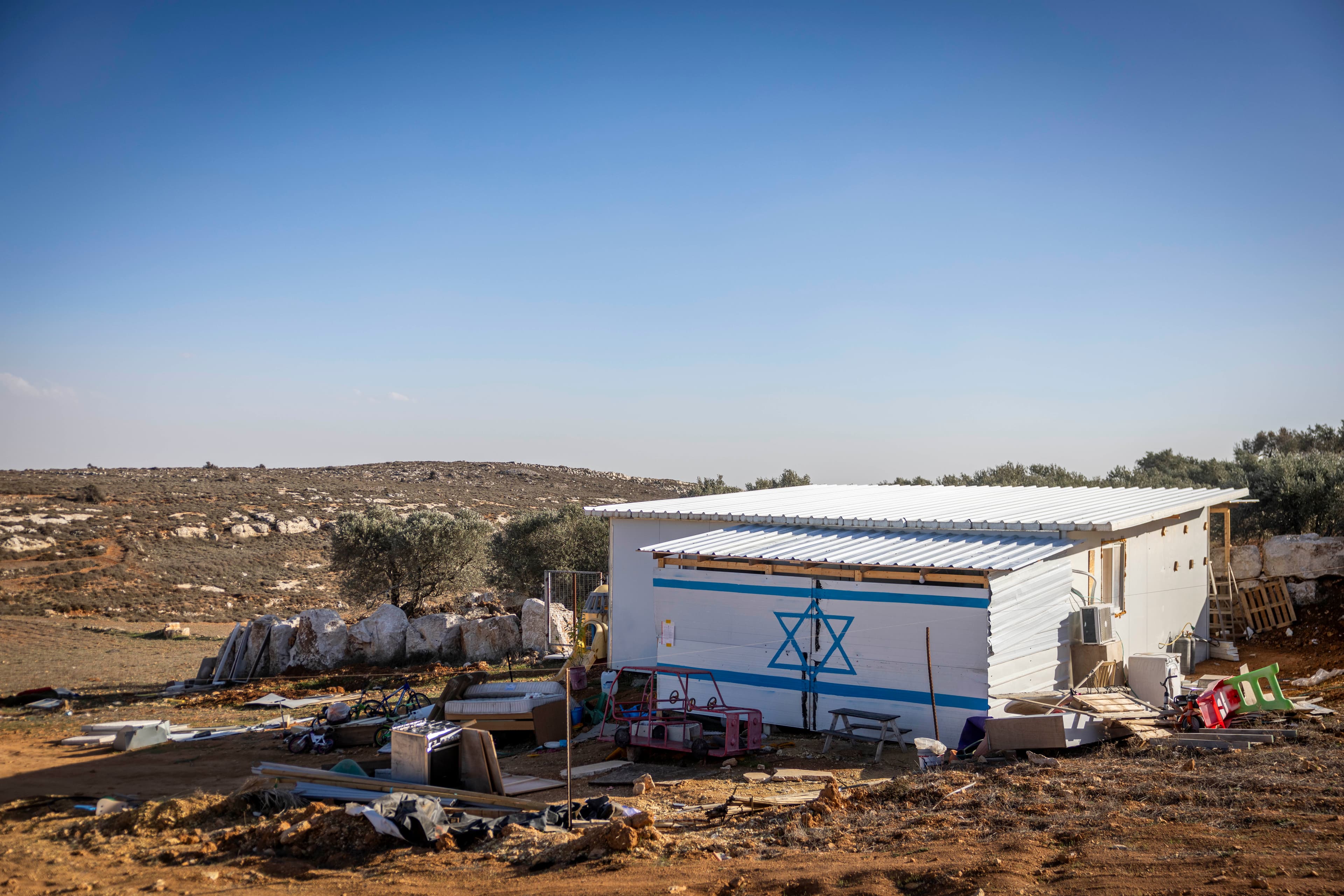
View of an illegal outpost in the Mateh Binyamin district in the West Bank, December 7, 2025. Photo: Chaim Goldberg/Flash90
“Greater Israel”: From Political Ideology to Territorial Practice
The existing claim of the Jewish national movement to all territories of historic Palestine becomes government policy in Israel
On 22 September 1967, a large advertisement appeared in several Israeli daily newspapers, signed by leading intellectuals of the country, including the poet Natan Altermann, the ideologue of the kibbutz movement Moshe Tabenkin, and the writer S.Y. Agnon. The sponsors of this advertisement, entitled “For Greater Israel,” captured the euphoria that gripped the country as a result of its greatest military success to date — which had led to a doubling of the territory controlled by Israel — in the state’s brief history. They wrote: “The Land of Israel is now in the hands of the Jewish people, and just as we are not permitted to forgo the State of Israel, so too we are enjoined to sustain what we have received from it: The Land of Israel.” This was followed by an appeal to the Israeli government to preserve this success in the long term.
Three months after the end of the June 1967 War, these demands were by no means new. They instead contributed to the formation of the revisionist current in the Zionist movement, inspired by biblical narratives, while simultaneously benefiting from the support of some left-wing Zionist groups. This ideology thus prepared the ground for a policy that has been accelerated since 2018, and radicalized since October 2023.
Greater Israel or “the Whole Land of Israel”?
Linguistically, a glance at the meaning of the term in Hebrew already provides an indication of the concept's appeal beyond radical messianic circles: while in English and German we speak of “Greater Israel” and “Groß-Israel,” in Hebrew, the literal term is “the whole land of Israel.” This choice of terms shows that what is at stake here is a supposed “wholeness” that has held Jewish-Israeli society together for decades, despite all rivalries.
Furthermore, even in liberal circles, the biblical terms “Judea and Samaria” have become the common designations for the occupied West Bank. What we have been seeing since the current Israeli government took office in December 2022 is therefore “merely” the accelerated codification of the Greater Israel ideology in coalition agreements, ministerial plans, bureaucratic measures, and violent military and paramilitary practices.
Finance Minister Smotrich regularly calls for the annexation of the entire West Bank and is currently pushing ahead with several projects designed to make national self-determination for Palestinians impossible.
Thus Israel's security policy narrative, which has existed since 1967 and claims that a Palestinian state would pose an existential threat to Israel, has given way in recent years to an open commitment to the ideology of Greater Israel — to such an extent that it has now risen to the rank of government doctrine.
The focus of media coverage — including in reports on the ongoing ethnic cleansing in parts of the West Bank — is currently on radical, messianic, and violent settlers and the Israeli army that supports them. These extreme actors are indeed the spearhead of a radicalized Jewish-Israeli society that is indifferent to the policies of occupation and expulsion. But how and why has the ideology of Greater Israel become an openly articulated political principle?
Military Rule over Palestinians
The occupation of the West Bank and the Gaza Strip nearly sixty years ago came as no surprise. Two factors were decisive: firstly, the conviction prevalent in large parts of the Zionist movement that they were superior to the indigenous Palestinians, and secondly, the desire that had existed since 1948 across party lines, and even at high military levels, to expand the territory of the State of Israel to encompass the whole of “Greater Israel”, that is historic Palestine.
While the first prime minister, David Ben-Gurion, who was in office (with only a brief interruption) from 1948 to 1963, refused to further expand the state's borders for pragmatic reasons, the discussion about concrete methods of rule and administration gained momentum under his successor, Levi Eshkol. The ideas developed within the political-military complex were based on the experiences of military rule over Palestinians within Israel since 1948. The methods of this military rule, which ranged from daily curfews, through surveillance in the education system, to deadly massacres, were now extended to the West Bank and Gaza, in some cases even by the same protagonists in the military.
The 1967 war, through which Israel took military control of the Gaza Strip from Egypt and the West Bank from Jordan, was not a “turning point” in this respect, but rather a catalyst for the Greater Israel policy. In the decades that followed, this policy of territorial expansion was supported by all Israeli governments and increasingly emphasized, especially in domestic political communication.
From Ideology to Government Policy
In 2018, the Israeli parliament passed the so-called Nation-State Bill (“Israel — the Nation-State of the Jewish People”). It was simultaneously elevated to one of the “basic laws” in the Israeli legal system, giving it additional normative force. The first sentence of the law echoes the demand made by the intellectuals in the newspaper advertisement quoted at the beginning: “The Land of Israel is the historical homeland of the Jewish People, in which the State of Israel was established. The State of Israel is the nation state of the Jewish People in which it realizes its natural, cultural, religious, and historical right to self-determination. The realization of the right to national self-determination in the State of Israel is exclusive to the Jewish People.”
The current Minister of Finance and Minister of Administrative Affairs for the West Bank, Bezalel Smotrich, played a key role in drafting this law. Smotrich, himself a settler, is regarded in parliament as the strategist behind the success of the “Greater Israel movement”. A year earlier, in September 2017, when he was already vice president of the Knesset, he published a document entitled “The Decisive Plan”. In it, he bluntly presents his vision of a State of Israel between the Mediterranean Sea and the Jordan River, which would require the annexation of all territories previously occupied by Israel. He argues that there needs to be practical and political awareness that “there is room for only one expression of national self-determination west of the Jordan River: that of the Jewish nation.”
Without an in-depth, self-critical examination of the notions of Jewish superiority that exist even within the liberal Zionist camp, no transformation directed towards the self-determination of both peoples is conceivable.
Smotrich has since risen to become Finance Minister and heads the Department for Civil Administration of the West Bank within the Ministry of Defence. He regularly calls for the annexation of the entire West Bank and is currently pushing ahead with several projects designed to make national self-determination for Palestinians impossible. After, in 2025, according to the UN Security Council, the construction of more than 47,000 new housing units in the West Bank had been advanced, approved, or put out to tender,the Israeli cabinet just recently decided to effectively divide the West Bank through the E1 construction project, located east of Jerusalem. International criticism was also drawn by the decision to register Palestinian land in Israeli registers as Israeli state land, giving Jewish Israelis the ability to acquire land in these areas.
The steps described here — in the shadow of the genocide of Palestinians in the Gaza Strip following the Hamas massacre of 7 October 2023, accompanied by Israeli efforts towards a large-scale “voluntary resettlement” of the remaining residents and the current military presence in over half of the almost completely destroyed coastal strip — can therefore be interpreted as the practical implementation of the principle laid down in the current coalition agreement: “The Jewish people have an exclusive and inalienable right to all parts of the Land of Israel … — Galilee, Negev, the Golan, and Judea and Samaria.”
Overcoming Notions of Superiority
What we have observed in recent years is the transformation into active government policy of what has always been a virulent idea, across the entire spectrum of Zionist political camps: the Jewish national movement’s claim to all territories of historic Palestine. A societal explanation for the success of this ideology — apart from the unscrupulousness of its champions in government circles and in the ideologically allied think tanks, non-governmental organizations, and activist groups — lies in the flawed perception of messianic notions of redemption by that portion of the Jewish-Israeli population which perceives itself as liberal. This was also evident during the most recent waves of protests against the government and for the release of Israeli hostages: here, too, the decisive role of messianic settlement policy and the associated dehumanization, expulsion, and oppression of Palestinians was largely ignored, declared irrelevant, or even supported.
One thing is certain: without an in-depth, self-critical examination of the notions of Jewish superiority that exist even within the liberal Zionist camp, no transformation directed towards the self-determination of both peoples is conceivable. Given the destruction, hatred, militarism, and violence that have characterized the region for so many years, and given the ideological foundations of Jewish-Israeli society, such a transformation cannot be expected to come only from within. Perhaps it will only be possible once a political solution — necessarily imperfect — brought about from outside creates the opportunity. Clearly, with the “peace council” currently being formed under Donald Trump, as well as a U.S. ambassador to Israel who openly speaks of Israel’s biblical territorial claims from the Nile to the Euphrates, this will certainly not be possible.
Translated by Hanna Grześkiewicz and Samuel Langer (Gegensatz Translation Collective)
Author
GIL SHOHAT is the head of the office in Israel, Rosa-Luxemburg-Stiftung, Tel Aviv
